Replay
Anonymous
- Spoken Word
Spoken Word
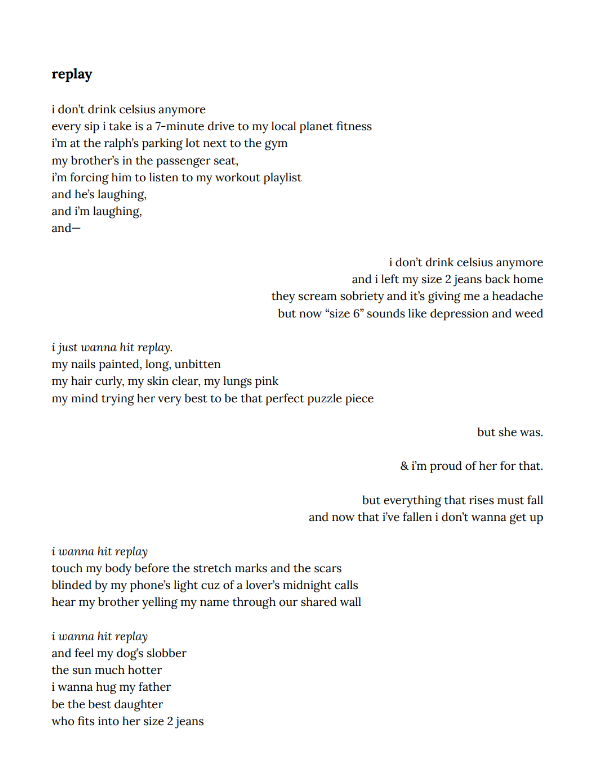
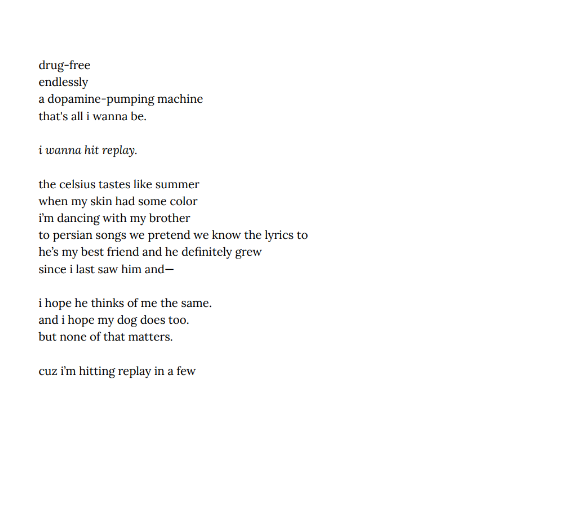
The poem “replay” emerged from an unexpected encounter with my own past. While cleaning through old belongings, I found journals from my time at my first institution, a period marked by emotional instability, loneliness, and an overwhelming need to understand myself. During that time, I wrote constantly. Journaling was how I managed the overflow of anger, sadness, and confusion.
Reading those entries years later, certain images and moments stood out. Such details that appear in the poem are drawn directly from those journal entries and the emotions that resurfaced as I reread them. What struck me most was not only the pain I was documenting, but the longing beneath it. The speaker in the poem is the girl living inside that difficult period. She remembers an earlier version of herself that she believes was stronger, more beautiful, more whole. She compares her present self to that imagined past and grows angry at what she sees. She convinces herself that the answer lies in pressing replay.
But replay, in this context, was not a plan for self-improvement. It was retreat. It was the instinct to close my eyes and romanticize a previous version of myself rather than face who I was becoming. It was nostalgia without action - imagining a better past instead of engaging with a painful present. Writing the poem became my way of examining that instinct. The repetition throughout the piece mirrors the mental loop I found in those journals: the urge to linger in memory rather than move forward. I chose to submit this piece as a recording because the repetition and cadence are central to its meaning, and hearing it aloud allows the emotional tension of that longing to be felt rather than simply read.
Transferring institutions added another layer to this experience. Moving between campuses meant carrying multiple versions of myself at once - the one before the struggle, the one inside it, and the one trying to write through it. There was comfort in idealizing a former identity because it felt fixed and familiar. But remaining there left me suspended, and it did not build anything new. Over time, my understanding of resilience shifted. It was not about reclaiming the girl I once believed was perfect. It was not about proving that I had become better than the one who struggled. In some ways, I had grown stronger. My health is steadier. My habits are more sustainable. My body and routines have changed. But
resilience is not defined by those external markers.
Resilience, for me, became the decision not to live in the past. It became recognizing that longing can feel comforting while quietly keeping you still. It became choosing movement over daydreaming, allowing myself to remember without mistaking memory for direction.
The urge to replay still surfaces at times, and that instinct is human. What has changed is my response. I no longer treat longing as a map back to who I was; I allow myself to evolve without ranking my past selves. The girl who journaled through pain, the one who longed for a perfect version of herself, and the one writing this reflection are not competing identities, but rather chapters of the same story.
“Replay” is not about returning to who I once was. It is about understanding why I wanted to, and choosing to move forward anyway.